


Recap: Right now we are exploring which way is up on the moral landscape (what separates a moral peak from a valley) so that we can later learn to navigate it.
In the last essay, we found that intrinsic value, being good or bad in itself, lives only in the experience of a conscious, subjective being. Without consciousness, there is no landscape.
In this essay, we take the landscape as given and ask how it is built: what in conscious experience creates its peaks and valleys. Where does good begin?
I’ll argue that the peaks and valleys come from how good or bad an experience feels. All of it is felt in the mind; there is nowhere else to feel it. But a feeling can start in two ways: externally, as a reaction to a signal the senses bring in from outside the mind, or internally, from something the mind makes on its own, like a memory or an idea. We start with the senses, the interface between the world and our minds. The next essay turns to the mind’s creations.
We Are Antennae to the World
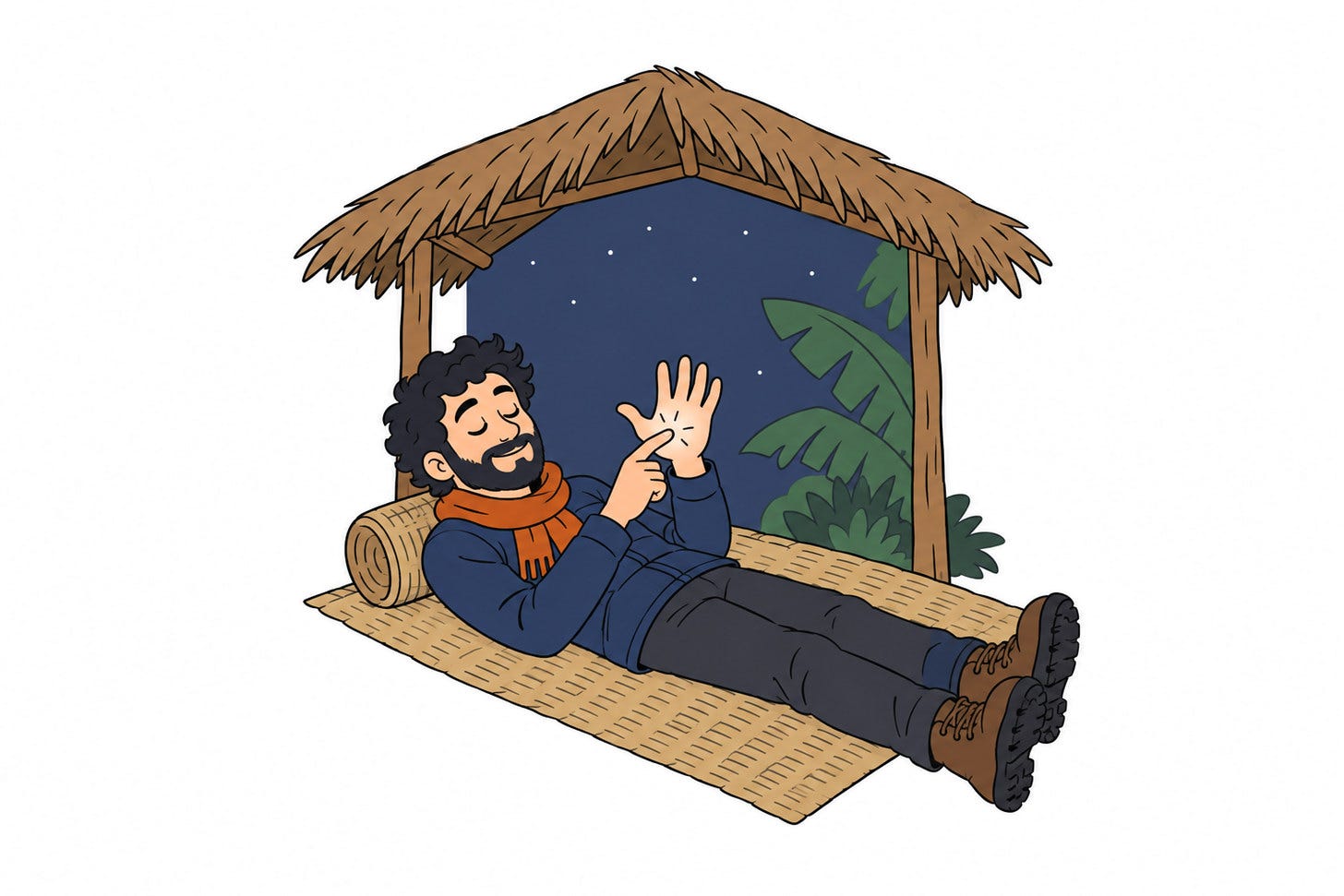
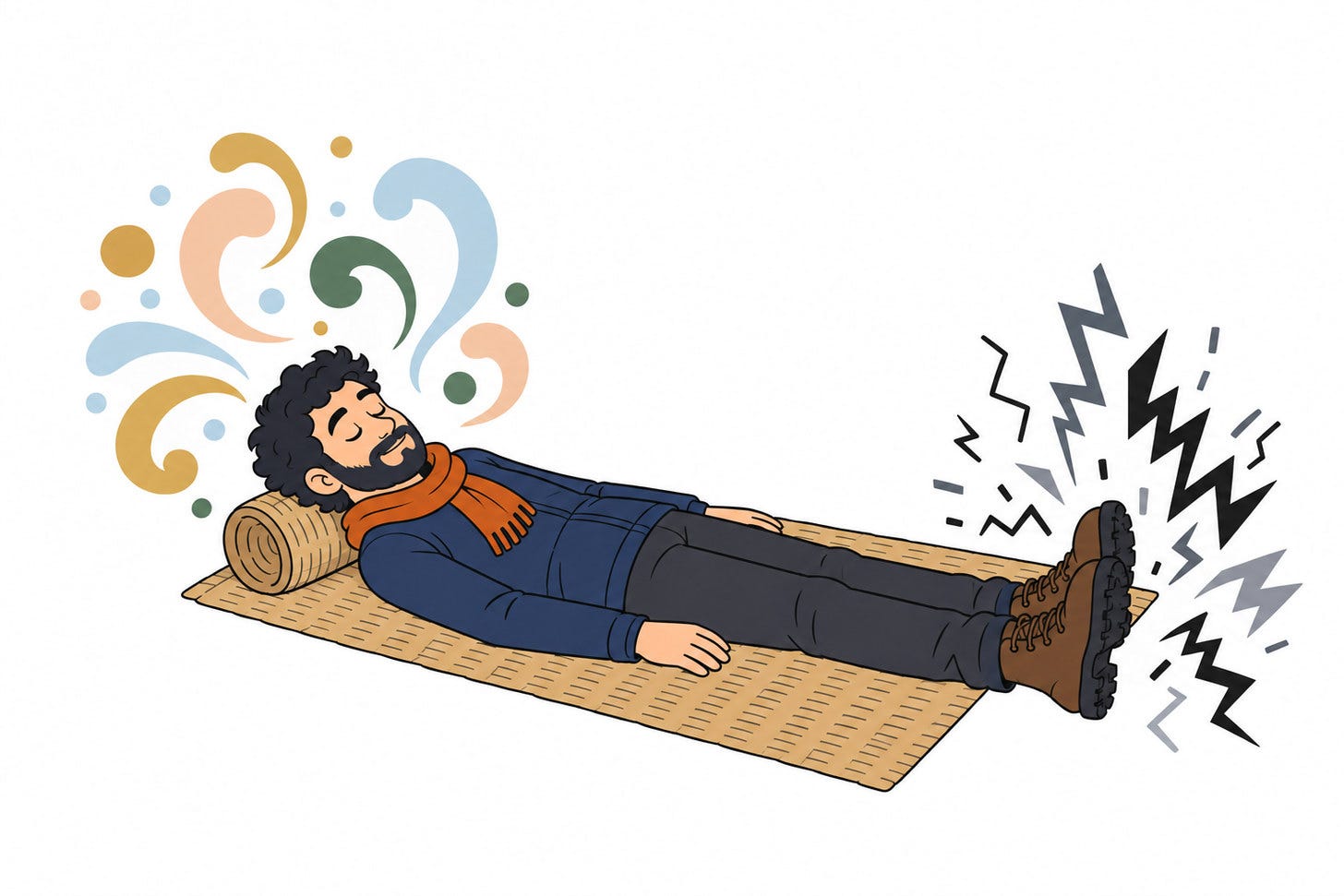
One night in the low jungle of the Peruvian Amazon, lying on a mat in an ayahuasca ceremony, I rediscovered my own mouth.
I kept running my tongue around it. I could feel every wet, square millimeter. Each nerve seemed to report its sensation independently. I could sense where my tongue ended at the back of my throat, as the nerves seemed to fade away the farther I let my mind trace down my esophagus. It was as if I had only ever felt my mouth before through a haze, and now I felt it in utter clarity.
Then I pressed my right finger into my left palm. Normally that registers as two points of pressure, one on the fingertip and one on the pad of my hand. Sometimes the two blur into a single feeling, even though my finger and palm are so far apart. But that night it registered as thousands. I again felt every nerve. It was the touch analogue of looking not just at a picture, but at every independent pixel too.
There’s a version of the human body resized by how much of the brain’s touch map each part takes up, called a cortical or sensory homunculus.1 I hesitate to share a picture of this ridiculous being, but it looks something like this:

That is roughly how I felt that night, all hands and mouth. Those parts take up the most room in the brain’s touch map, and I seemed to be receiving their input raw, before my brain could smooth it into one picture.
Normally, sensory input is processed and abstracted to drive action in a changing, threatening environment. For my first three decades, I took my senses for granted. They were always on, and I had never known life without them. I processed their representations in my mind (I see a man, I hear singing, I feel pain in my back), but in that moment, I was interacting with my sight, sound, and touch directly. It felt as if I were meeting my senses for the first time.
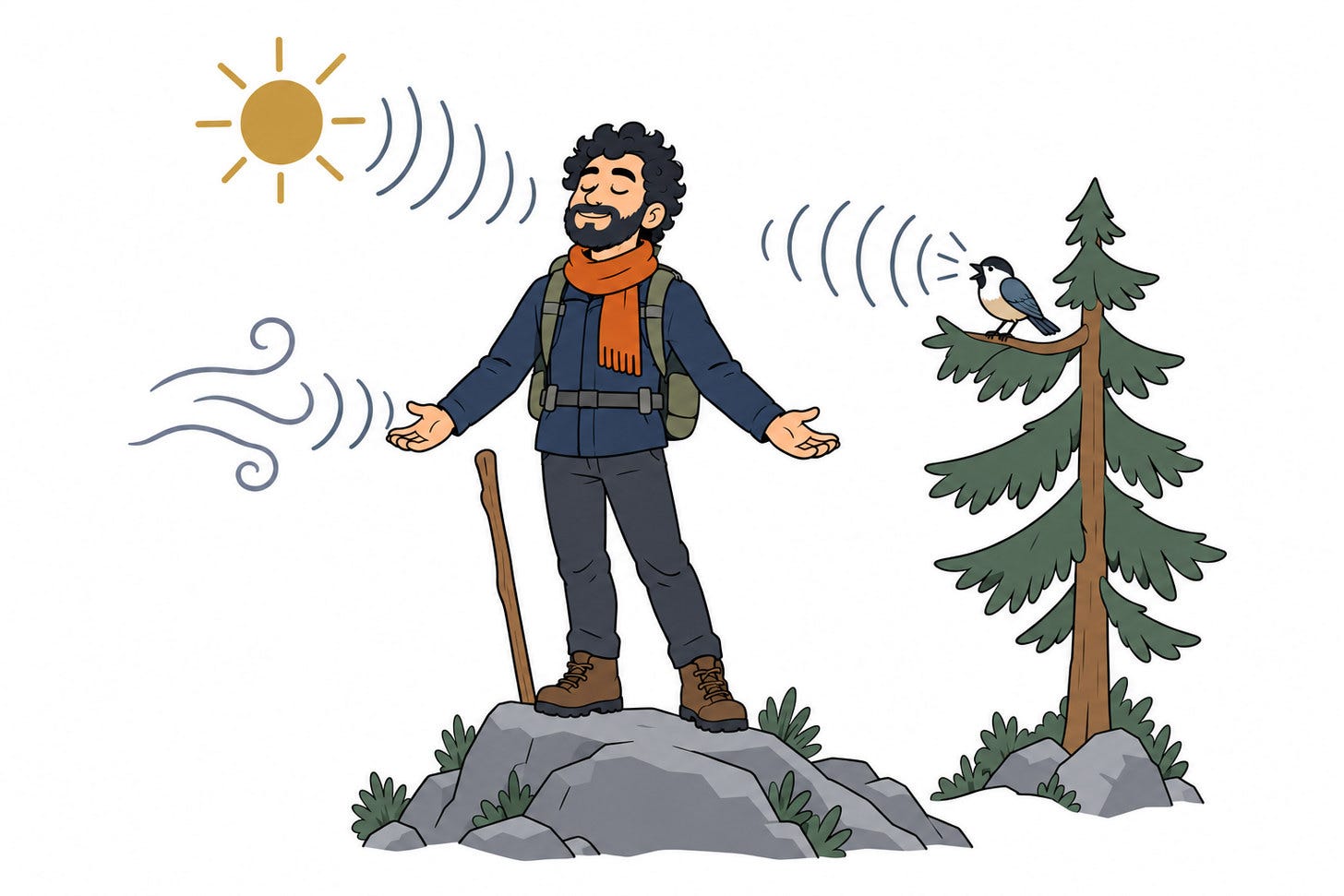
A camera measures light. A microphone measures sound. A thermometer measures heat. We do all of that at once, and we sense inwardly too: balance, the position of our limbs, hunger and thirst, the beat of our own hearts, even the passing of time. We are antennae to the world.
It has to be this way. Life that cannot sense its surroundings cannot survive. Even a single bacterium must sense the world around it to navigate. Before anything could experience the world, something had to survive in it, and to survive, it had to sense.
That night in the jungle showed me why the senses matter for a moral landscape. If value lives in subjective experience, then how the external world enters that experience decides what we can feel, and so what can matter. It enters through the senses, the interface between our subjective minds and the external universe.
Feelings Form the Landscape
Antennae may pick up signal, but they don’t tell us whether that signal is good or bad. A camera doesn’t care what it films. A microphone records a horrified scream and a soothing lullaby as sound waves all the same. A raw signal just is.
If all conscious experience lacked a positive or negative charge, there would not be much of a moral landscape to navigate: it would be a wide, flat field, with no state of the universe better or worse than any other.
Those who meditate know that if you focus on sensations, you can often feel the charges fade.2 If all conscious creatures lived in permanent meditative equanimity, the moral landscape would collapse to flatness. No positive peaks or negative valleys, and thus no reason to navigate upward or downward.
In that world, we might be conscious but, morally speaking, no different from the philosophical zombies of the last essay, who have no inner experience at all. Someone would be home, and still nothing could go better or worse for us. For a mind with no charge, there is no moral landscape to navigate, nowhere one should go. Might as well stay put. Unsurprisingly, monks who seek nirvana (an extinguishing of passions and suffering) traditionally practice in a cave, monastery, or similar solitude.
Equanimity is not nothing: a mind with no charge has left every valley. But it is not realistic. We might imagine a conceptual but false human: Homo equanimus. This is the perfectly equanimous human, who experiences the world without a charge at all times. This is analogous to Homo economicus, economists’ construction of a perfectly rational human. Of course, humans are not perfectly rational; Homo economicus fails to capture mankind’s true economic behavior.
Homo equanimus is as fictional as Homo economicus. A moral map has to describe the ground people actually walk on. Understanding how to navigate a moral landscape must take into account how we experience the world in our default mode, in our ordinary, unmeditative states, not just in meditative equanimity.
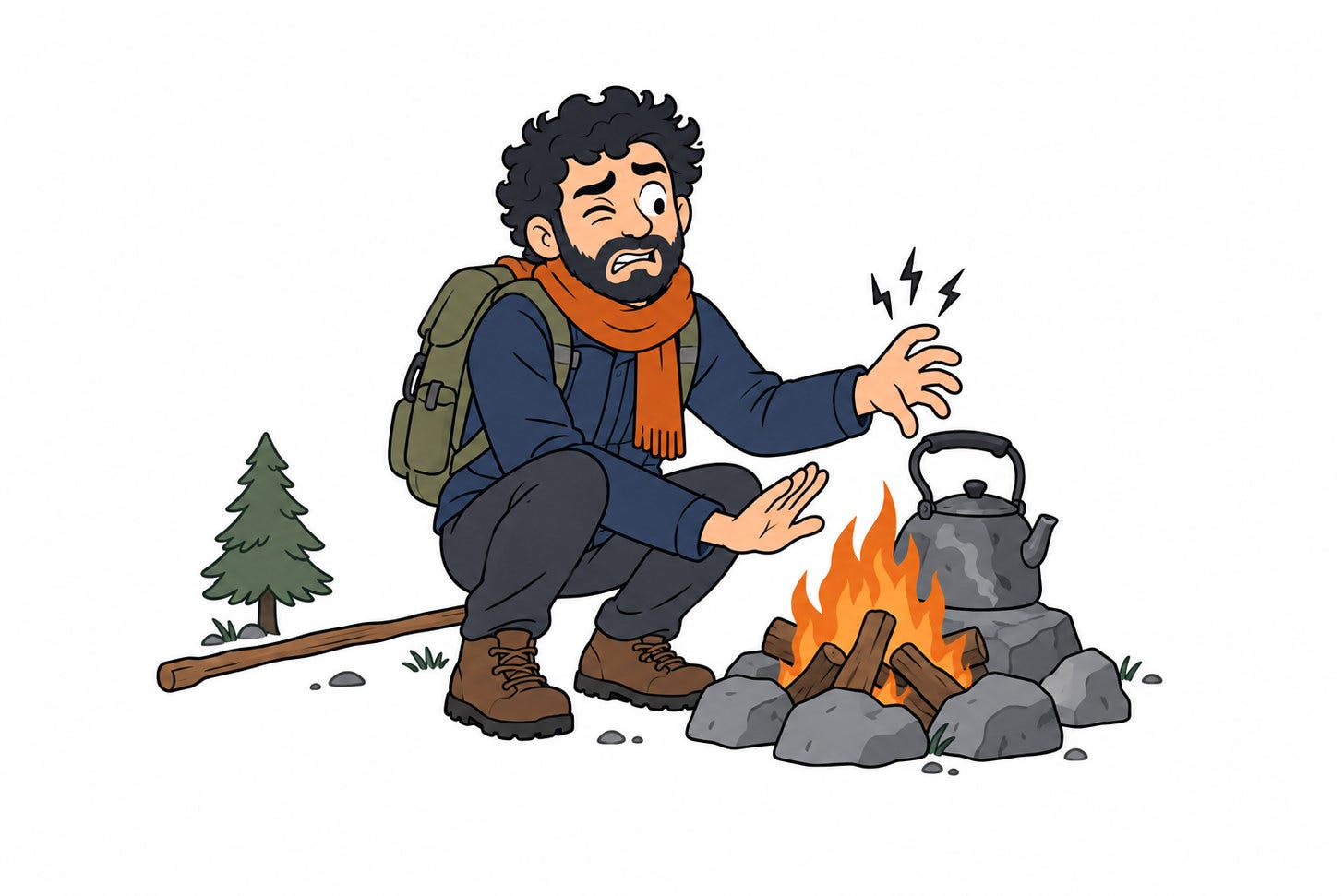
Real experiences vary, and our signals usually arrive charged. Warmth feels good; a hot stove feels bad. Sugar tastes good; rot smells bad. Evolution built a filter over our experience, coloring the raw signal with positive and negative feelings.
Picture a baby a few seconds old. Cold air hits her skin. Bright light floods her eyes. A strange sound reaches her ears. She has no words for any of it and has been taught nothing, yet she cries. The signals arrived already charged.
Creatures drawn toward warmth and food, and repelled by burns and rot, lived long enough to pass that wiring on. Natural selection tuned the charges over millions of years to steer us toward safety and away from harm.
Evolution explains which way the charges point but not why they are felt. Perhaps we could have been stimulus and response without qualia, internal subjective feeling. The question of why we feel is called the hard problem of consciousness,3 and this essay does not solve that problem. That we know we feel with positive and negative charge at all is all our landscape needs.
In the real world, we Homo sapiens mostly ride atop our feelings. For most of our day, our experience carries some positive or negative charge. We can call that charge an experience’s valence. I take this as a premise: if value lives in experience, as the last essay found, then valence is what makes one experience better or worse than another. Some states of the world bring more positive charges: the landscape’s hills and peaks. Others bring more negative ones: its valleys. The moral landscape for an individual (not yet society, more on that later) begins to form.
The Highest Peak, The Deepest Valley
Most days valence runs mild: the small pleasure of a good coffee, the small sting of a curt email. The landscape often has hills, not mountains. I found its extremes in Peru. The night I described above was one of a series of ceremonies on back-to-back nights, and two of those nights took me to the highest peak and the deepest valley I have ever reached.
One night was bliss. For hours I floated in an ecstatic, nearly orgasmic state: beautiful colors, a fantastical dreamland, the gentle chanting of the maestros’ icaros (healing songs), and every nerve ending in my body flooded with pleasure. This was not a state of consciousness that had ever been accessible in my normal life: it was full-body, sensory ecstasy.
The next night, I took a larger dose and was shot into hell. Every sense was turned up to maximum and then smashed, over and over. My eyes were closed, yet my visual field raced through sinister colors and shapes that changed millisecond by millisecond, too fast to grasp. The same chants now sounded demonic, laced with overloaded static. My body writhed. My hands kept moving on their own to my mouth and face, among the most nerve-dense parts of the body, grabbing for any stimulation that might drown out what I was feeling. And it felt endless: my sense of time stretched each minute longer and longer towards eternity.
I left this experience in part terrified, but in large part grateful. As the others on the retreat and I came down from the medicine, we laughed at just how flabbergasting the experience could be. For someone hoping to explore the moral landscape from its highest mountaintop to its deepest valley, these two nights were illuminating.
Good and bad valences don’t derive wholly from sensory pleasure and pain (the next two essays take that up), but these nights showed me what those contributions could look like. For me, the peak had every nerve ending flooded with pleasure. The valley had every sense turned up to maximum and smashed, overloaded.
I left Peru dramatically more attuned to my senses. I’ve returned to normal: the thousands of nerves in my palm have fused back into a single touch. But I know now that they are there, thousands in every palm and hundreds of thousands across the body,4 each reporting on the world and affecting the valence of our experience in it.
Where Good Begins
The last essay found that intrinsic value lives only in the experiences of conscious, subjective beings. Conscious experiences can originate internally or externally. Those that start externally come through the senses, our way of engaging with the external world, and what they bring in often arrives charged.
Simply, this means that the state of the external world has bearing on the shape of the moral landscape. Value still lives only in experience, but through the senses, the world affects much of experience’s charge. In the last essay’s terms, the world’s value is instrumental: it matters because of what it makes conscious beings feel.
Moving forward:
We presume that within experience, valence, how positive or negative it feels, is what makes one experience better or worse than another. Take the charge away, and the landscape goes flat.
Much of that valence starts externally, as a reaction to what the senses bring in, with charges tuned by evolution. The senses are the antennae by which our subjective minds connect with the external world. That world matters, for what it makes us feel.
These claims say where good and bad begin. They do not yet say how a charge on the senses becomes a charge on a person, a party, a faith, or any other idea. In the next essay, we follow valence from the senses into the concepts we build upon them.
Wilder Penfield and Theodore Rasmussen, The Cerebral Cortex of Man (New York: Macmillan, 1950).
Fadel Zeidan et al., “Brain Mechanisms Supporting the Modulation of Pain by Mindfulness Meditation,” Journal of Neuroscience 31, no. 14 (2011): 5540–48. After four days of training, meditating cut the unpleasantness of a painful stimulus by 57 percent.
David J. Chalmers, “Facing Up to the Problem of Consciousness,” Journal of Consciousness Studies 2, no. 3 (1995): 200–219.
Giulia Corniani and Hannes P. Saal, “Tactile Innervation Densities across the Whole Body,” Journal of Neurophysiology 124, no. 4 (2020): 1229–40. They estimate about 230,000 touch fibers across the body, and about 17,000 on the palm side of each hand.